- ARTICLE

RPA Developer: Roles, Skills, Benefits And Challenges
Discover how digital marketing for small business drives growth in Riyadh using smart strategies, local SEO, paid ads, and expert guidance.
Discover how digital marketing for small business drives growth in Riyadh using smart strategies, local SEO, paid ads, and expert guidance.
Introduction
Businesses today are increasingly looking for ways to reduce repetitive work, improve efficiency, and operate more accurately. Robotic Process Automation (RPA) has become one of the most effective technologies for achieving these goals. RPA uses software bots to automate rule-based tasks such as data entry, document processing, report generation, and system updates, and an RPA developer is responsible for designing and building these automation solutions.
At Aseef IT Co Holding, we have seen how automation can significantly improve operational efficiency across industries such as finance, healthcare, logistics, and enterprise operations. By implementing RPA solutions for businesses, organizations are able to streamline workflows, reduce human errors, and free employees to focus on strategic work.
As automation adoption continues to grow, the role of the RPA developer has become essential. These professionals design and build automation bots that allow businesses to scale operations and improve productivity without increasing manual workload.

What Is A RPA Developer?
Understanding An RPA Developer.
An RPA developer refers to a technology professional responsible for designing, developing, and maintaining software bots that automate repetitive digital tasks. In simple terms, RPA developer means a specialist who converts manual workflows into automated digital processes that improve efficiency and accuracy.
Developers at Aseef regularly work with organizations to transform manual workflows into automated processes. They collaborate with business teams to identify tasks that follow clear rules and can be executed automatically through software bots.
RPA developers typically build automation solutions that interact with enterprise software such as ERP systems, CRM platforms, and internal databases. Their expertise ensures that automation integrates smoothly with existing systems while maintaining operational security and process accuracy.

What Does RPA Developer Do?
Overview of RPA Developer Responsibilities.
Automation projects typically involve multiple stages, and the responsibilities of an RPA developer extend across the entire automation lifecycle. Based on industry practices and the experience of developers at Aseef, these responsibilities usually include:
Process Analysis
Our RPA developers analyze business workflows to identify repetitive tasks that are suitable for automation. This step ensures that automation delivers measurable efficiency improvements.
Bot Development
Developers build software bots using specialized RPA platforms to automate tasks such as extracting data, updating systems, processing transactions, and generating reports.
Workflow Design
Our RPA experts design structured automation workflows that allow bots to interact with multiple applications while maintaining accuracy and consistency.
Testing And Debugging
Before deployment, automation workflows are tested in simulated environments to ensure they perform correctly and handle potential errors.
Deployment And Maintenance
Once automation is implemented, developers monitor bot performance and update workflows when business processes or software systems change.
Documentation And Support
We ensure proper documentation so that automation solutions remain scalable and maintainable for long-term business use.

What Are 5 Essential Skills Required For RPA Developer?
Overview of Essential RPA Developer Skills.
Through practical automation projects and industry implementations, several key skills have proven essential for RPA developers.
1. Knowledge Of RPA Platforms
Developers must understand automation platforms such as UiPath, Automation Anywhere, and Blue Prism, which are widely used to build automation workflows as part of enterprise RPA development services.
2. Process Analysis Skills
Automation specialists at Aseef often emphasize that identifying the right processes for automation is one of the most important steps. Developers must carefully evaluate workflows to determine where automation will deliver the greatest value.
3. Programming Knowledge
Although many RPA platforms offer low-code capabilities, knowledge of programming languages such as Python, Java, or C# allows developers to build advanced automation and integrate complex systems.
4. Database And Data Handling
Many automation workflows interact with enterprise databases. Understanding data structures and SQL helps developers manage data efficiently within automated processes.
5. Analytical Thinking
Automation requires logical problem-solving. Developers must design workflows that can handle multiple conditions, exceptions, and process variations.
Does An RPA Developer Need To Know Programming?
Programming Requirements In RPA Development.
One of the most common questions about RPA development is whether programming skills are required.
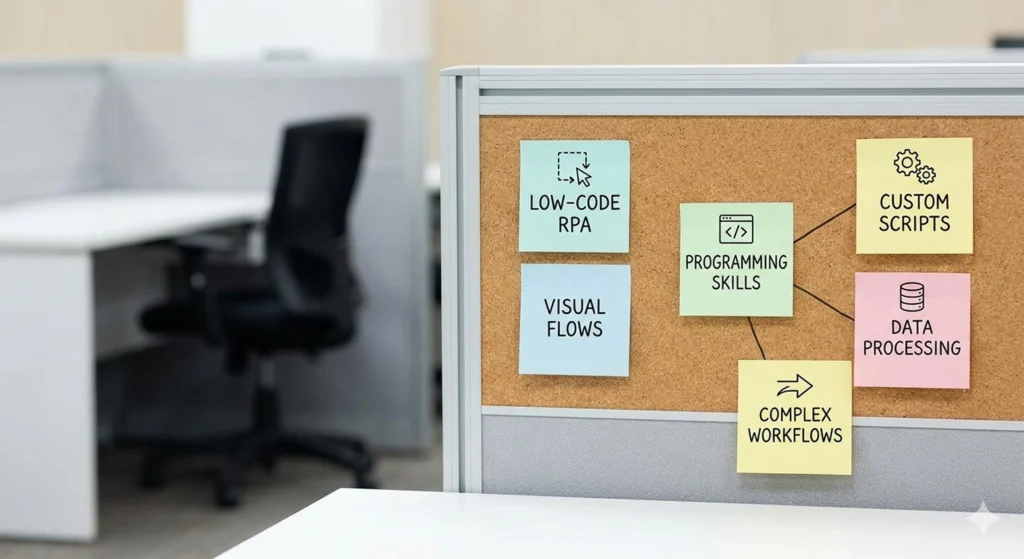
Based on automation implementations handled by the team at Aseef , many RPA platforms are designed as low-code environments, allowing developers to create automation workflows using visual interfaces instead of extensive coding.
However, programming knowledge becomes extremely valuable when developers need to:
- Integrate automation with external APIs
- Build custom scripts or automation logic
- Process large datasets
- Develop complex automation workflows
For this reason, while programming may not always be required for beginners, it significantly enhances an RPA developer’s capabilities in enterprise environments.
RPA Developers vs. Software Developers
Key Differences Between RPA Developers And Software Developers.
Although both roles work within the technology domain, their focus areas are different.
At Aseef IT Holding Co, our RPA experts and software development teams work closely together to deliver end-to-end digital solutions, combining automation capabilities with full-scale application development to support enterprise transformation.
Aspect | RPA Developer | Software Developer |
Primary Goal | Automate existing business processes | Build new software applications |
Development Tools | Automation platforms and workflow tools | Programming languages and frameworks |
System Interaction | Works with existing software systems | Builds systems from scratch |
Typical Projects | Task automation, workflow automation | Web apps, mobile apps, enterprise systems |

What Are The Benefits And Challenges Of Being An RPA Developer?
Benefits
1.Growing Demand For Automation
Organizations across industries are investing heavily in automation. Automation specialists at Aseef continue to see increasing demand for RPA solutions as businesses look for ways to improve efficiency and scalability.
2.Opportunities Across Industries
RPA solutions are used in sectors such as banking, healthcare, retail, manufacturing, and logistics, offering developers diverse career opportunities.
3. Strong Career Growth
Experienced RPA professionals often progress into roles such as automation architects, intelligent automation consultants, or digital transformation specialists.
4.Real Business Impact
Automation directly improves operational performance, allowing developers to contribute to measurable business results.
Challenges
1.Rapidly Evolving Technology
Automation tools and technologies evolve quickly, requiring developers to stay updated with new platforms and capabilities.
2.Process Complexity
Not all workflows are suitable for automation. Developers must carefully analyze processes to determine automation feasibility.
3.System Integration Issues
Enterprise environments often contain legacy systems, making automation integration technically challenging.
4.Continuous Monitoring
Automation bots must be monitored and updated regularly to ensure they remain reliable as business processes evolve.

Conclusion
RPA developers play a vital role in helping organizations automate repetitive processes and improve operational efficiency. By building software bots that handle routine tasks, they enable businesses to reduce manual effort, increase accuracy, and improve productivity.
Teams working on automation projects at Aseef have observed that companies implementing RPA effectively gain a clear advantage in operational efficiency and scalability.
As automation continues to expand across industries, the demand for skilled RPA developers will continue to grow. Professionals who combine technical expertise, analytical thinking, and hands-on automation experience will be well positioned to succeed in this rapidly evolving field.
Blog Summary
This blog, “RPA Developer: Roles, Skills, Benefits And Challenges,” explains the complete role of an RPA developer and their importance in modern automation-driven businesses.
It begins by introducing Robotic Process Automation (RPA) and how it helps organizations automate repetitive tasks such as data entry, reporting, and workflow processing. An RPA developer is responsible for designing and building software bots that improve efficiency, reduce errors, and streamline operations.
The blog further explains the key responsibilities of an RPA developer, including process analysis, bot development, workflow design, testing, deployment, and documentation. It also highlights the essential skills required, such as knowledge of RPA platforms, programming, database handling, and analytical thinking.
Additionally, it discusses whether programming skills are necessary, explaining that while RPA tools are often low-code, programming knowledge enhances advanced automation capabilities. A comparison between RPA developers and software developers is also provided to clarify their different roles in technology ecosystems.
Finally, the blog covers the benefits and challenges of being an RPA developer, emphasizing strong career growth, cross-industry opportunities, and real business impact, along with challenges like evolving tools and system integration complexities.
Overall, it concludes that RPA developers play a critical role in driving digital transformation and automation success across industries.
Frequently Asked Questions (FAQs)
1. Why are RPA developers important for businesses?
RPA developers help organizations automate repetitive tasks, reduce human errors, improve productivity, and streamline operations across systems such as ERP, CRM, and databases.
2. What skills are required to become an RPA specialist?
Key skills for an RPA developer include knowledge of RPA platforms like UiPath, Automation Anywhere, and Blue Prism, programming knowledge, workflow analysis, database management, and strong analytical thinking.
3. Do RPA experts need programming skills?
Programming is not always mandatory for beginners because many RPA platforms are low-code. However, knowledge of languages like Python, Java, or C# helps developers create advanced automation and integrate complex systems.
4. What industries hire RPA specialists?
RPA developers are in demand across industries such as banking, healthcare, retail, logistics, manufacturing, and finance where repetitive processes can be automated.
5. What tools do RPA experts commonly use?
Popular RPA tools include UiPath, Automation Anywhere, and Blue Prism. These platforms allow developers to design automation workflows and deploy software bots.
6. What are the benefits of hiring an RPA developer?
Hiring an RPA developer helps businesses reduce costs, improve accuracy, and increase efficiency. At Aseef IT Co Holding, developers build automation solutions that streamline workflows and boost productivity.
Publication Date
Category
- RPA Development
Table of Contents

Let’s start a project today
Start your project with us and unlock innovative solutions tailored to your needs. Our team is ready to bring your ideas to life and deliver exceptional results.




Let's start a project today
Start your project with us and unlock innovative solutions tailored to your needs. Our team is ready to bring your ideas to life and deliver exceptional results.
Request Solution