- ARTICLE

Cybersecurity Threats: Understanding Today’s Digital Risks
Explore how AI in digital marketing boosts efficiency, personalised content, and improves ROI with automation, analytics, and smart strategy.
Explore how AI in digital marketing boosts efficiency, personalised content, and improves ROI with automation, analytics, and smart strategy.
INTRODUCTION
In today’s hyper-connected digital world, cybersecurity threats are one of the biggest risks facing individuals, businesses, and governments. They involve malicious actions intended to steal data, disrupt systems, damage infrastructure, or exploit vulnerabilities for financial or strategic gain. Such threats can compromise the confidentiality, integrity, and availability of information systems and digital assets the core goals of modern cybersecurity.
What Is A Cybersecurity Threat?
A cybersecurity threat is any circumstance or event with the potential to negatively impact an organization, system, or individual by compromising digital systems or data. These cybersecurity threats include attacks that aim to steal, corrupt, deny access to data, or interrupt normal operations. Cyber threats can affect people, processes, networks, and technologies across personal and business environments. When digital systems are targeted for unauthorized access, data theft, disruption, or sabotage, that activity is a cybersecurity threat.
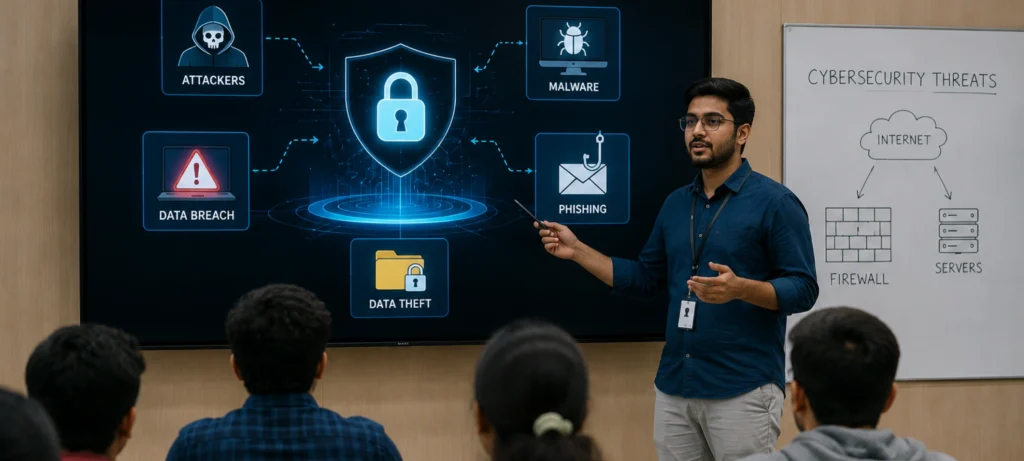
Why Cybersecurity Threats Matter?
- Data breaches expose sensitive information:
Cyber threats often result in unauthorized access to personal, financial, or business-critical data. Once exposed, this information can be misused for fraud, identity theft, or competitive advantage, and in many cases, the damage cannot be fully reversed. - Reputational damage and loss of trust:
A security incident can seriously harm an organization’s reputation. Customers and partners may lose confidence in how data is handled, leading to reduced loyalty, negative publicity, and long-term brand damage that extends beyond the initial breach. - Significant financial losses:
The financial impact of cyber threats goes beyond stolen money or ransom payments. Organizations frequently face costs related to system recovery, legal actions, regulatory penalties, increased insurance premiums, and investments required to strengthen security afterward. - Operational disruptions and downtime:
Cyberattacks can interrupt day-to-day operations by disabling systems, locking access to data, or shutting down critical services. These disruptions affect productivity, delay service delivery, and can result in lost revenue, especially for digitally dependent businesses. - An expanding and complex threat landscape:
As digital adoption increases through cloud computing, mobile applications, IoT devices, and artificial intelligence.This expansion makes it more difficult to maintain consistent security and allows cyber threats to evolve alongside new technologies.

Common Types of Cybersecurity Threats & Risks
Below are some of the most prevalent and impactful cyber threats affecting organizations today:
1. Malware (Malicious Software)
Malware represents software designed to damage, steal, or disrupt systems. This includes:
- Ransomware – Locks or encrypts data until a ransom is paid
- Viruses & worms – Self-replicating code infecting systems
- Trojan horses – Hidden threats disguised as legitimate software
- Spyware/Adware – Tools that harvest data secretly
- Cryptojacking – Unauthorized use of computing power to mine cryptocurrency
2. Phishing & Social Engineering
These attacks exploit human psychology rather than technology. Cybercriminals trick users into revealing credentials or downloading malware by impersonating trustworthy sources via:
- Fake emails or messages
- Deceptive websites
- Voice/text communication scams (smishing/vishing)
3. Insider Threats
Not all threats come from the outside. Insider threats occur when employees, contractors, or partners misuse legitimate access, either intentionally or by mistake. These are especially dangerous since they can bypass many traditional defenses.
4. Advanced Persistent Threats (APTs)
APTs are long-term, targeted attacks conducted by organized groups (e.g., nation-state actors or criminal syndicates) focused on sustained access and data theft rather than quick disruption.
5. Denial-of-Service (DoS) & DDoS Attacks
These attacks overwhelm systems with traffic, making services unavailable to legitimate users. Distributed attacks use networks of compromised devices to amplify impact.
6. Zero-Day Exploits
These threats exploit vulnerabilities before they are known or patched by vendors, giving attackers a “zero-day” advantage.
- Password & Credential Attacks
Hackers steal, guess, or brute-force login credentials to gain unauthorized access. Techniques include credential stuffing and targeted phishing.
8. Supply Chain Attacks
Attackers target third-party vendors or software providers to compromise an otherwise secure organization, a growing threat vector in 2025 and beyond.
9. IoT & Connected Device Vulnerabilities
As more devices connect to corporate networks (smart sensors, cameras, etc.), each one becomes a potential entry point for attackers.

Emerging Cyber Threats
Cyber threats evolve with technology. Recent trends include:
- AI-enabled cyber attacks:
Attackers are increasingly using artificial intelligence and generative models to enhance their techniques. AI allows cybercriminals to create highly convincing phishing messages, fake identities, and automated attack campaigns that adapt in real time. These attacks are harder to detect because they closely mimic legitimate communication and user behavior. - Fileless attacks:
Unlike traditional malware, fileless attacks do not rely on malicious files stored on a system. Instead, they execute directly in memory, often using trusted system tools to carry out malicious actions. This approach helps attackers avoid detection by traditional antivirus solutions and makes forensic investigation more challenging. - Quantum computing implications:
Although still emerging, quantum computing presents potential future risks to cybersecurity. As quantum capabilities advance, existing cryptographic algorithms may become vulnerable, potentially exposing encrypted data. This has prompted growing interest in quantum-resistant encryption methods and long-term security planning. - The need for adaptive security strategies:
As cyber threats become more sophisticated, static security measures are no longer sufficient. Staying ahead requires continuous threat intelligence, real-time monitoring, and security systems that can adapt to new attack techniques. Organizations must evolve their defenses at the same pace as the threats they face.

How Cyber Threats Are Delivered
Aseef protects organizations from cybersecurity threats through layered security and monitoring.
Malicious links and attachments:
Cyber threats are often delivered through emails, messages, or websites that contain harmful links or infected attachments. These are designed to look legitimate, encouraging users to click or download files that silently install malware or redirect them to fake login pages.
Exploiting unpatched software:
Attackers actively scan for systems running outdated software with known vulnerabilities. When security updates are delayed or ignored, these weaknesses can be exploited to gain unauthorized access, deploy malware, or move laterally within a network.
Social engineering tactics:
Many cyber threats rely on manipulating human behavior rather than exploiting technical flaws. Attackers impersonate trusted individuals or organizations to persuade users to share credentials, approve access, or bypass security controls, often without realizing they are being targeted.
Remote access tools:
Legitimate remote access software can be abused by attackers to maintain control over compromised systems. Once installed, these tools allow threat actors to monitor activity, steal data, or deploy additional malicious payloads while remaining difficult to detect.
Botnet-based attacks:
In botnet attacks, large networks of compromised devices are controlled remotely to carry out coordinated actions such as distributed denial-of-service (DDoS) attacks, spam campaigns, or large-scale credential abuse. The scale of these networks amplifies the impact of each individual attack.

How aseef Helps Your Organization Stay Protected from Cybersecurity Threats
Aseef protects organizations from cybersecurity threats with continuous monitoring and layered security.
Multi-layered security posture:
Relying on a single security control is no longer effective against modern cyber threats. A layered approach combines firewalls, endpoint protection, intrusion detection and prevention systems, and secure system configurations to reduce the likelihood that a single vulnerability can be exploited. This approach helps contain threats even if one defense layer is bypassed.
Employee education and awareness:
Human behavior plays a major role in many cybersecurity incidents. Educating employees about phishing, social engineering, and safe digital practices helps reduce the risk of accidental breaches. When users understand common attack tactics, they are better equipped to recognize suspicious activity and avoid actions that could compromise security.
Regular patching and updates:
Unpatched systems remain one of the most common entry points for attackers. Keeping software, operating systems, and applications up to date ensures known vulnerabilities are addressed before they can be exploited. Regular updates also help maintain system stability and reduce exposure to emerging threats.
Strong authentication practices:
Weak or reused passwords continue to be a significant risk. Strong authentication measures such as multi-factor authentication, password managers, and controlled session access make it more difficult for attackers to gain unauthorized entry, even if credentials are compromised.
Threat intelligence and continuous monitoring:
Cyber threats are constantly evolving, making real-time visibility essential. Threat intelligence feeds and continuous monitoring help identify unusual behavior, potential intrusions, and emerging attack patterns early. This allows organizations to respond more quickly and limit potential damage.
Incident response planning:
Even with strong defenses, no organization is immune to cyber incidents. Having clear incident response plans and predefined playbooks ensures teams know how to act when a breach occurs. This reduces confusion, speeds up recovery, and minimizes the overall impact on operations and reputation.

Conclusion
Aseef helps organizations stay protected as cybersecurity threats are varied, sophisticated, and constantly evolving. Understanding what they are, how they work, and how to defend against them is essential for individuals and organizations operating in the digital age. Proactive security strategies, regular training, and adaptive defenses are no longer optional they are fundamental.
Blog Summary
Cybersecurity threats continue to evolve as businesses become increasingly dependent on digital technologies, cloud platforms, connected devices, and remote operations. These threats range from malware and phishing attacks to insider threats, ransomware, and advanced persistent attacks that can disrupt operations, compromise sensitive data, and cause significant financial and reputational damage.
Understanding cybersecurity threats is essential for organizations seeking to protect their systems, employees, and customers. Common threats exploit both technical vulnerabilities and human behavior, using tactics such as deceptive emails, credential theft, software exploits, and social engineering to gain unauthorized access to critical systems and information.
Emerging risks such as AI-powered cyberattacks, fileless malware, supply chain compromises, and potential quantum computing vulnerabilities are making the threat landscape more complex. As attackers adopt new technologies and techniques, organizations must continuously adapt their security strategies to detect, prevent, and respond to evolving threats.
Effective cybersecurity requires a proactive approach that combines layered security controls, employee awareness training, regular software updates, strong authentication practices, threat intelligence, and continuous monitoring. Organizations that invest in these measures are better equipped to reduce risk, maintain business continuity, and strengthen resilience against modern cybersecurity threats.
Cybersecurity is no longer just an IT concern—it is a critical business priority. By understanding the most common cybersecurity threats and implementing comprehensive security practices, organizations can better protect their digital assets, maintain customer trust, and operate confidently in an increasingly connected world.
AI is redefining how marketing operates—but it’s not about chasing trends. Real results come when AI tools are aligned with strategy, supported by clean data, and guided by human creativity. With a thoughtful, ethical, and data-driven approach, AI can scale campaigns and improve outcomes without disrupting your workflow.
Frequently Asked Questions (FAQs)
1. What are cyber security threats?
Cyber security threats are malicious actions or events that aim to compromise digital systems, networks, or data. These threats can involve data theft, system disruption, unauthorized access, or damage to digital infrastructure.
2. Why are cyber security threats increasing?
Cyber security threats are increasing due to rapid digital adoption, including cloud computing, mobile applications, IoT devices, and remote work. As technology expands, attackers gain more opportunities to exploit vulnerabilities across interconnected systems.
3. What is the most common type of cyber security threat?
Malware and phishing attacks remain among the most common cyber security threats. Malware disrupts or steals data, while phishing exploits human trust to gain unauthorized access to systems or credentials.
4. Can small businesses be affected by cyber security threats?
Yes, small businesses are frequently targeted because they often lack advanced security measures. Cybercriminals view them as easier entry points, making them vulnerable to data breaches, ransomware, and phishing attacks.
5. How do cyber security threats impact businesses?
Cyber security threats can lead to financial losses, operational downtime, reputational damage, and legal consequences. Even a single incident can disrupt services and reduce customer trust.
6. Are cyber security threats preventable?
While no system is completely immune, many cyber security threats can be reduced through layered security, employee awareness, regular updates, and continuous monitoring. Proactive defense strategies significantly lower overall risk.
Publication Date
Category
- Cyber Security
Table of Contents
Let’s start a project today
Start your project with us and unlock innovative solutions tailored to your needs. Our team is ready to bring your ideas to life and deliver exceptional results.




Let's start a project today
Start your project with us and unlock innovative solutions tailored to your needs. Our team is ready to bring your ideas to life and deliver exceptional results.
Request Solution