- ARTICLE

Odoo Training: A Complete Guide for Teams and Beginners
Selecting the best Odoo development company is crucial for streamlining workflows, handling operations, and customizing ERP systems according to business needs. Right from developing modules and integrating them to implementation and support services, selecting the right Odoo development agency can prove beneficial for businesses. Firms in Saudi Arabia are now adopting Odoo to streamline workflows, manage business operations and process data effectively. Following are 10 Odoo development agencies that firms can consider while comparing services and industry experience.
Explore how AI in digital marketing boosts efficiency, personalised content, and improves ROI with automation, analytics, and smart strategy.
Introduction
ERP implementation in businesses requires not only adequate software but also trained employees who know how to use the system, perform their everyday tasks, and follow the workflow. This is why Odoo training is crucial to help the company get the most out of its ERP solution.
Odoo unites different areas in one solution such as sales, accounting, inventory, CRM, human resources, and manufacturing. However, without training, employees can face many problems related to new workflow, errors in data entry, or simply using spreadsheets instead of ERP.
Whether a business in Saudi Arabia is adopting Odoo for the first time, preparing for implementation, or helping an existing team improve its ERP skills, a structured training program can support smoother adoption and more efficient operations.
This guide explains the different types of Odoo training, the skills employees need, and how businesses can build a practical training program that supports long-term system adoption.

Why Is Odoo Training Important for Businesses?
1. Enhance Productivity of Employees
When employees become familiar with Odoo applications, they will perform their daily tasks without making mistakes and without having to manually do things.2. Odoo Application Adoption
As the workflow in Odoo application may differ from their workflow, employees may resist using a new application. Through training, users get an opportunity to ask questions about the application and learn new things before using the application independently.3. Avoiding Errors while Entering Data
There could be mistakes in the customer data, incomplete transactions, and the inaccurate entry of the inventory which may have an impact on several departments.4. Promoting Cooperation among Various Departments
Odoo integrates different business apps via common records and workflow. Employees will know how their work impacts other departments.5. Improve Usage of Odoo Applications
Companies may use Odoo without fully harnessing the potential of the applications they have. Training will help employees realize the benefits of applications, reports, automation, and other processes related to their needs.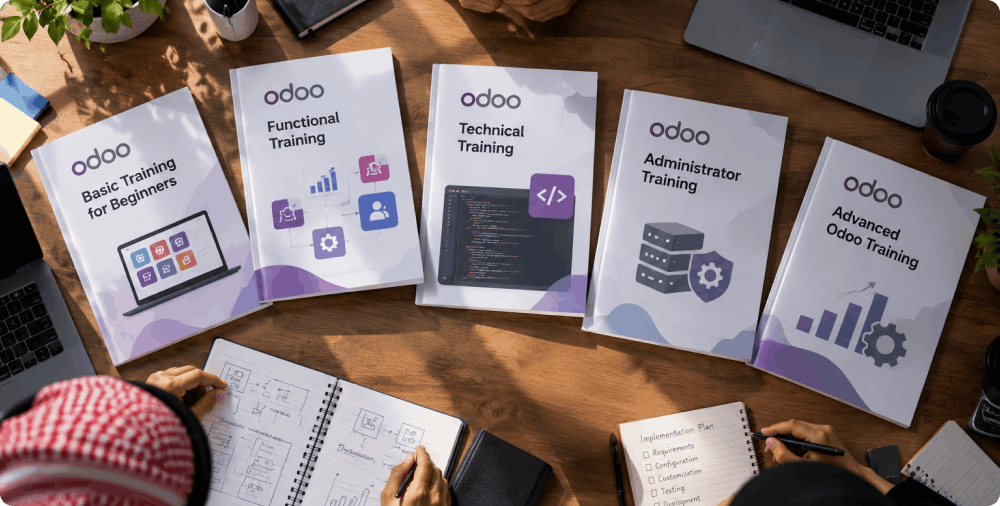
Types of Odoo Training for Different Business Needs
The right training program depends on each user’s responsibilities, existing knowledge, and the complexity of the business processes they manage.
1. Odoo Basic Training for Beginners
Odoo basic training gives beginners an introduction to Odoo system and its key capabilities. It is designed for employees who have little or no experience with ERP systems and work with a company that uses Odoo.
Topics covered in the training are:
- Navigation through Odoo interface and applications.
- Record creation and updating.
- Basics about dashboards, notifications and activities.
- Information search and report generation.
- Basics of user permission management and data handling.
- This training serves as a basis for further employee involvement in departmental activities.
2. Odoo Functional Training
Odoo functional training is all about using applications in running business operations on a day-to-day basis. It targets employees, team leaders, and managers who need to learn how Odoo can help them perform better.
Based on the implemented applications, this training will include:
Sales and CRM: Lead management, customer interactions, quotations, and sales orders.
Accounting: Invoicing, payment entry, and financial reporting.
Inventory: Stock management, incoming stock, outgoing stock, and stock adjustments.
Purchasing: Vendor management, purchase order, and suppliers’ transactions.
Human Resources: Employee data, leave management, and attendance.
Manufacturing: Bill of materials, manufacturing orders, and work orders.
In terms of Odoo applications to be covered in the training, it is important to consider what departments use most.
3. Odoo Technical Training
Odoo technical training is designed for developers and IT experts who are going to extend or maintain Odoo software.
The topics might include:
- Knowledge of Odoo architecture and module structure.
- Development of custom modules.
- Coding using Python and XML within Odoo application development.
- Configuration of views, models, and business logic.
- Odoo integration with other applications via API.
- Debugging and maintaining custom functionality.
The training will be useful for businesses with custom Odoo software or integrations with existing applications.
4. Odoo Administrator Training
The skills required by the system administrator are not the same as those required by other business users. This task includes maintenance of the system configuration, access management, and dependable daily operation.
Administrator training may include topics like user setup, role access permissions, application setup, company configuration, and basic problem-solving methods. Administrator training may also consist of an overview of backup strategies and escalation procedures.
The goal of such training is to enable administrators to run the system properly without restricting employees’ access to it.
5. Advanced Odoo Training
The advanced training will benefit those users who have knowledge about Odoo because it will allow them to use the software efficiently for configuration and automation. It is useful for those groups of people who are efficient in doing routine tasks but need complex workflow management.
These include advanced reports, automation activities, workflow approval, dashboard design, and application configuration. The training program should be designed based on the current implementation of the software in the organization.
How to Create an Effective Odoo Training Program
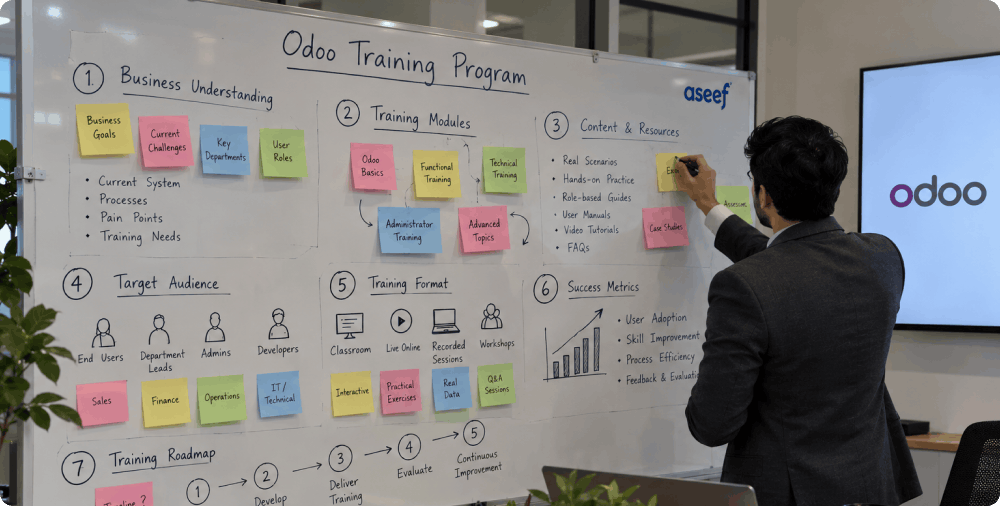
Step 1: Identifying Training Requirements
Start with identifying who requires the training and what exactly needs to be done in Odoo. Analyzing the skill set, workflow, and issues that occur while working will prove helpful in the process. For example, the finance department may need training in payment reconciliation and the warehousing department may need training in stock transfer and delivery confirmation.Step 2: Defining Training Objectives
Define the objective of each training session. Instead of getting the employees to learn the entire application, focus on what tasks they need to perform independently. For example: Creating a quotation and converting it to a sales order. Receipt of payment from a customer based on the invoice. Inwarding of the goods and managing inventory. Submitting and approving leave application by an employee. Creating reports and analysis of the same.Step 3: Schedule Role-Based Training Classes
Organize the employees depending on their roles and workflows. This ensures that the class is relevant to the users and avoids them wasting time on training unnecessary features. The classes organized for specific departments should also cover how these tasks are connected within the organization. For example, members of the sales department should understand how an order confirmation will impact inventory, shipping, and billing.Step 4: Offer Hands-on Training Exercises
Users get an opportunity to learn by doing through hands-on training. The users should not be spectators but rather active participants in all the activities done by the trainer. Create exercises based on the business rules and workflow configured in the application. Include exceptions like wrong quantity, missing data, or an invoice requiring review. The practice environment is especially important since the users can make mistakes without impacting live business data.Step 5: Assessing User Readiness
Prior to asking the employees to operate independently, it is necessary to evaluate whether or not they have the ability to do their critical tasks. There are ways such as practical assessment, guided task completion, and short tests that will identify the areas that require further support. Managers must look into the employee’s capability in terms of accuracy, compliance with the work flow, and resolving basic issues, rather than just considering the attendance record.Step 6: Post Training Support
There must be training even after the initial training process is done. The employees may have some queries regarding how to use Odoo in their day-to-day activities, especially during the first month after the implementation of the software.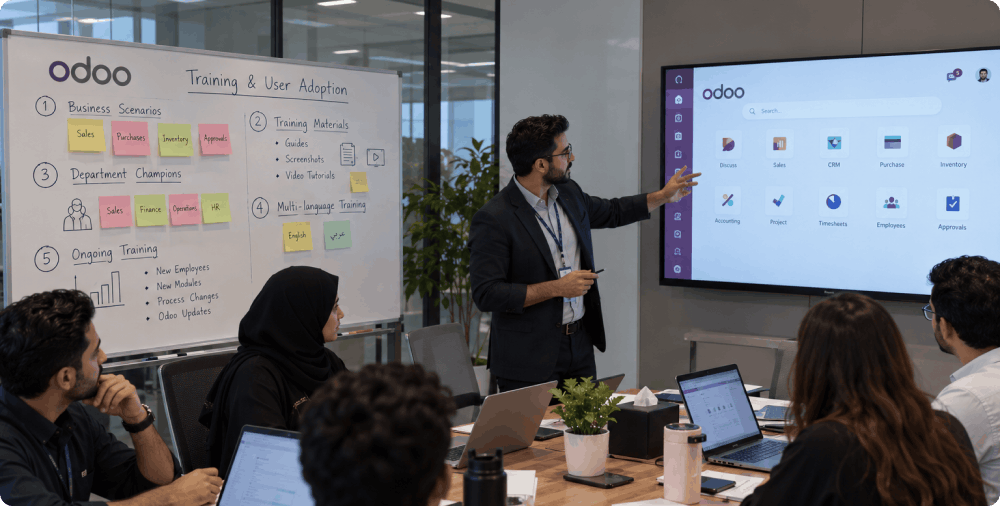
Best Practices for Odoo Training and User Adoption
1. Apply Relevant Business Scenarios
Training must be realistic. Use real products, customers, approvals, and reporting procedures. This way, it will be much simpler for the staff to see how Odoo can assist them in fulfilling their responsibilities.2.Make Training Materials Concise
Provide concise instructions, guidelines, screenshots, and video tutorials of the most popular processes. They may be categorized according to the process or department in order to clarify certain aspects. Training materials must be updated each time when there are any changes in workflows, configurations, and Odoo versions.3.Train Champions for Each Department
Champions must be selected from among those employees who are aware of the workflow in their departments and can answer frequently asked questions. This way, not only will the training be reinforced but these champions will also be able to pinpoint the difficulties and give feedback to the administrators or the implementation team. They must have a plan of action if they require any technical assistance.4.Train Staff Based on Preferred Language
In case there is a presence of several different languages among the staff, the training should be conducted in such a way that everybody could understand it. For example, in companies working in Saudi Arabia, it is possible to provide trainings in Arabic and English because both languages are used within the team. What is really important is to make the procedure clear, particularly when it is related to financial, regulatory or customer records approval.5.Adapt Training to Company Changes
New staff joining the company, new applications of Odoo, changes in the approval process, or changes of Odoo itself become reasons for the need in training.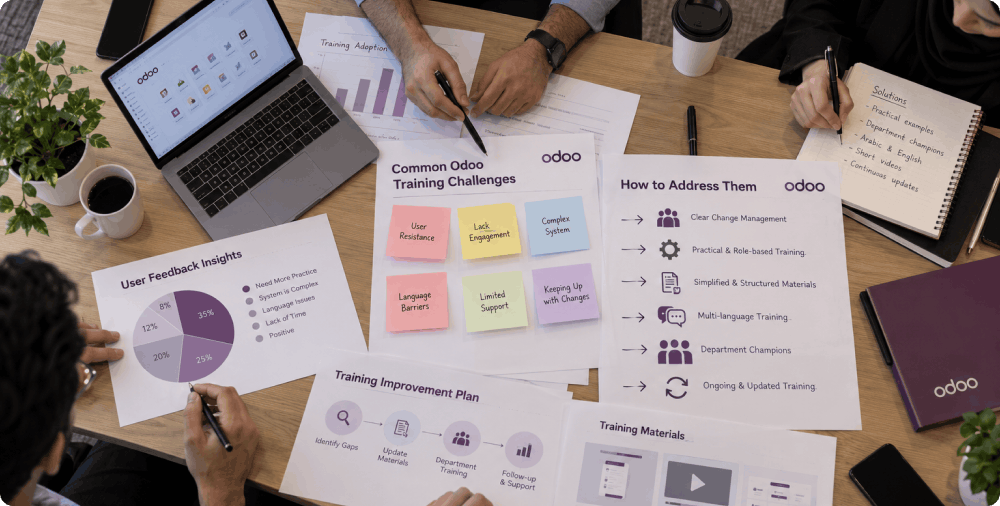
Common Odoo Training Challenges and How to Address Them
Problem: Users are overwhelmed by too many applications and their features in a limited time.
Solution: Break down training into smaller sessions and focus on the most important tasks that users need to perform. Teach more sophisticated features as the employees get more experienced.
Problem: Employees are still using spreadsheets and manual procedures rather than Odoo procedure.
Solution: Explain the reasons behind the work flow and show users what the benefits are. Give them time to practice the new procedure and gather feedback from the employees to clarify difficult parts.
Problem: Some users learn faster, and some need extra help.
Solution: Test skill levels before starting training and organize beginners, intermediate, or advanced groups depending on need
Problem: The demands of the job make it difficult for employees to attend long training periods.
Solution: Provide short task-based training sessions and recorded demonstrations or manuals. Organize training around operational tasks and key implementation phases.
Problem: Employees fail to remember procedures that they do not practice often.
Solution: Reinforce the learning process with practical activities, searchable documentation, regular updates, and guidance during operational work.
Problem: Employees fail to remember procedures that they do not practice often.
Solution: Reinforce the learning process with practical activities, searchable documentation, regular updates, and guidance during operational work.

How to Measure the Success of Odoo Training
Training must be determined not in terms of attendance but in how effectively employees apply Odoo.
Several metrics can be tracked for that:
- Tasks completion: Can employees complete essential workflows on their own?
- Data completeness: Is the data complete, accurate, and entered properly?
- Compliance with process: Do users follow the mandatory approval process?
- Odoo implementation: Is the system used by employees or do they maintain paper copies?
- Support queries: Does the number of repeating questions and elementary use cases decrease over time?
- Process efficiency: Does the number of avoidable delays, repetitions, and manual interventions decrease?
The above metrics must be viewed from the perspective. The rise of support inquiries right after go-live is quite normal, as employees start working with the new system.
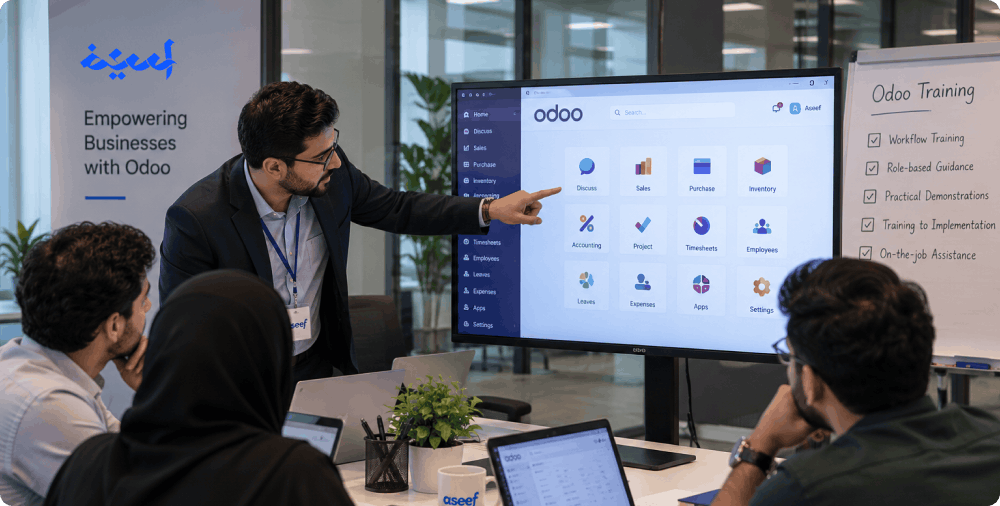
How Aseef Supports Odoo Training and Implementation
The training program should reflect the specifics of a company’s ERP system configuration, its operations, and employee duties. While generic demonstrations will explain how to access various features of the software, effective training also implies knowledge of how these features are going to work.
Aseef offers various services related to Odoo, including implementation, development, Odoo customization, integration, and support to help businesses align their ERP systems with operational requirements.
Business-oriented training can imply such elements as:
- Workflow Training: Explaining how Odoo applications will help perform day-to-day business tasks.
- Role-based Guidance: Focusing on features and functionality needed by each employee.
- Practical Process Demonstrations: Using relevant examples to show how routine transactions and workflows should be done.
- Training to Implementation: Preparing users to the system configured and processes introduced during implementation.
- On-the-job assistance: Identifying gaps in knowledge and helping employees adapt to the system.
The extent of the training should be decided depending on the applications selected, degree of customization, and needs of each particular user group.
If your business plans to implement Odoo or make improvements in using its ERP system, Aseef will assist you in designing a training program.
CONCLUSION
Odoo training helps businesses turn ERP functionality into practical skills that employees can apply in their daily work. From basic navigation and functional applications to technical development and system administration, the right training equips each user to perform their responsibilities with greater confidence.
A structured program should begin with clear learning objectives, focus on role-specific workflows, and provide opportunities for hands-on practice. Regular assessments, accessible learning materials, and post-implementation support help reinforce those skills over time.
For businesses implementing Odoo or improving an existing setup, training should be treated as an ongoing part of ERP management rather than a one-time activity.
Aseef can help your business align its Odoo requirements, implementation, and user support with its operational goals. Contact the team to discuss an Odoo approach that fits your business needs.
Blog Summary
- Explains how Odoo training helps businesses improve employee productivity, reduce errors, and streamline daily operations.
- Covers different types of Odoo training, including basic, functional, technical, administrator, and advanced training.
- Outlines the steps for creating an effective training program through requirement analysis, role-based sessions, hands-on practice, assessments, and post-training support.
- Highlights best practices for improving user adoption, addressing common training challenges, and measuring training success.
- Explores how Aseef supports businesses with customized Odoo training, practical demonstrations, implementation guidance, and ongoing assistance.
- Answers frequently asked questions about Odoo training, learning time, department-specific training, and the importance of continuous learning.
Frequently Asked Questions (FAQs)
Is Odoo easy for beginners to learn?
Odoo can be approachable for beginners, especially when training starts with basic navigation and the applications relevant to their roles. Hands-on practice and clear process guides help users become familiar with the system.
What is included in Odoo training?
Odoo training could include basics of navigation, functionality of applications, technical development, system administration, reports, and workflow configuration. The list of subjects depends on the tasks performed by the learners and the Odoo implementation in the company.
How much time is needed to learn Odoo?
The time for mastering the application varies depending on the position, previous experience in ERPs, and task difficulty. Users could learn to perform simple operations quickly, whereas administrators and developers need more targeted training and practice.
Can Odoo training be tailored for specific departments?
Yes. It can be tailored for such departments as sales, finance, inventory management, HR, procurement, and manufacturing. Role-specific classes will enable users to concentrate on the most appropriate applications and workflows.
Does Odoo technical training differ from functional training?
Yes. While functional training revolves around the usage of Odoo applications for performing business functions, technical training encompasses topics like module development, system architecture, customizations, and integration.
When should Odoo training be conducted – before or after implementation?
Odoo training must start at the stage of implementation planning and continue throughout the configuration of the system. The employees will have time to learn the fundamentals and practice workflows prior to their going live as well as get further assistance when working with live business data.
Why is continuous Odoo training essential?
Continuous training is essential for employees to adapt to new applications, changed workflows, system modifications, and evolving business needs.
Publication Date
Category
- ERP Software
Table of Contents
- Introduction
- Why Is Odoo Training Important for Businesses?
- Types of Odoo Training for Different Business Needs
- How to Create an Effective Odoo Training Program
- Best Practices for Odoo Training and User Adoption
- Common Odoo Training Challenges and How to Address Them
- How to Measure the Success of Odoo Training
- How Aseef Supports Odoo Training and Implementation
- Conclusion


Let’s start a project today
Start your project with us and unlock innovative solutions tailored to your needs. Our team is ready to bring your ideas to life and deliver exceptional results.




Let's start a project today
Start your project with us and unlock innovative solutions tailored to your needs. Our team is ready to bring your ideas to life and deliver exceptional results.
Request Solution